


We introduce Camille Aubry, who will once again be live illustrating parts of the BTS online festival this year.
Camille has been working as a freelance illustrator for over 12 years. She collaborates with researchers, creatives and community groups to co-create visual representations able to explain and expand their projects. Social and climate justice, as well as care and accessibility, are core values of her practice where she strives to amplify marginalised voices. Since December 2019, she has been a permanent resident of the Watershed’s Pervasive Media Studio in Bristol, where she experiments with creative technologies and cross-disciplinary collaborations in order to explore innovative ways to tell stories.
We took the opportunity to ask her some questions about herself and her work.
Can you tell us how you got into live illustration?
Originally I was taking part in traditional French “concerts dessinés” (drawn concerts), where illustrators like me were invited to draw live to music on stage. The shift to live illustration for events happened quite organically as I get into a similar headspace where I draw while listening.

Camille’s self-portrait
Why is it a good way to capture an event or conversation?
Live illustration is dependent on what is happening, and in many ways, the visual output is actually co-created with its audience. It offers a visual legacy of the event and keeps the momentum going. The work is not only about capturing key thoughts and ideas that are being said, but also perceptions and dynamics that written minutes, photos and videos simply can’t document.
How do you decide what to include and what to leave out? Is it sometimes difficult to decide?
A lot of the work is actually about listening to the quieter voices in the room, amplifying them and making them feel heard, so I don’t really approach it as having to record everything that is being said. On that subject the words of Carol Gilligan about radical listening are extremely apt:
“Radical listening means listening for the under-voice, tuning one’s ear to the conversation under the conversation. What remains unspoken until someone asks the question, or questions the culture that has driven a voice into silence.”
Following this idea, as a live illustrator I feel a duty of “cutting through the noise”.
A lot of people are surprised that you’re able to ‘keep up’ with what’s being said and produce illustrations at the same time. Is this your superpower, or did you have to practice a lot?
The process of drawing while listening has been part of my life since I am very little. To be honest, it is the only way I can focus on what is happening. It helps me regulate, sometimes I feel that it is a stimming behaviour that I somehow managed to turn into a job! Of course practice helps, but I am sure that a lot of people might resonate with the yearn to doodle during a conversation…
This is your second time working with Beyond the Spectrum: do you have any reflections on the programme, and why it means so much to people?
Working with Beyond the Spectrum is a joy, especially as a neurodivergent person myself. Too often we are treated as problems to be “solved” by culture, rather than creator and/or consumer of culture. Programmes like Beyond the Spectrum help us celebrate differences as part of the creative process away from “coping” strategies that unhelpfully frames neurodivergence through a deficit-based perspective.
As we’re a writing organisation, do you have a favourite book, author, or poem?
With the heartbreaking war currently happening in Iran I really want to celebrate women artists of the country. The graphic novelist (and so much more) Marjane Satrapi has always been a great inspiration, especially with her books Persepolis and Embroideries. I am also very drawn to the work of the feminist poet Forough Farrokhzad who explored the themes of love, femininity and social justice through her writing.
What’s your ideal way to spend a free day?
Drawing in a café with my kids.
Describe yourself in three words.
Nice words? Creative, brave and caring
Not so nice? Angry (although I don’t think anger is a bad thing), impatient and impulsive
Is there anything else you’d like to add?
I have just published a new comic book in collaboration with author and screenwriter Nikesh Shukla. It is called Mad Villain, and it is the story of a middle-aged father of two in Bristol who decides to join Antifa. It is available here:
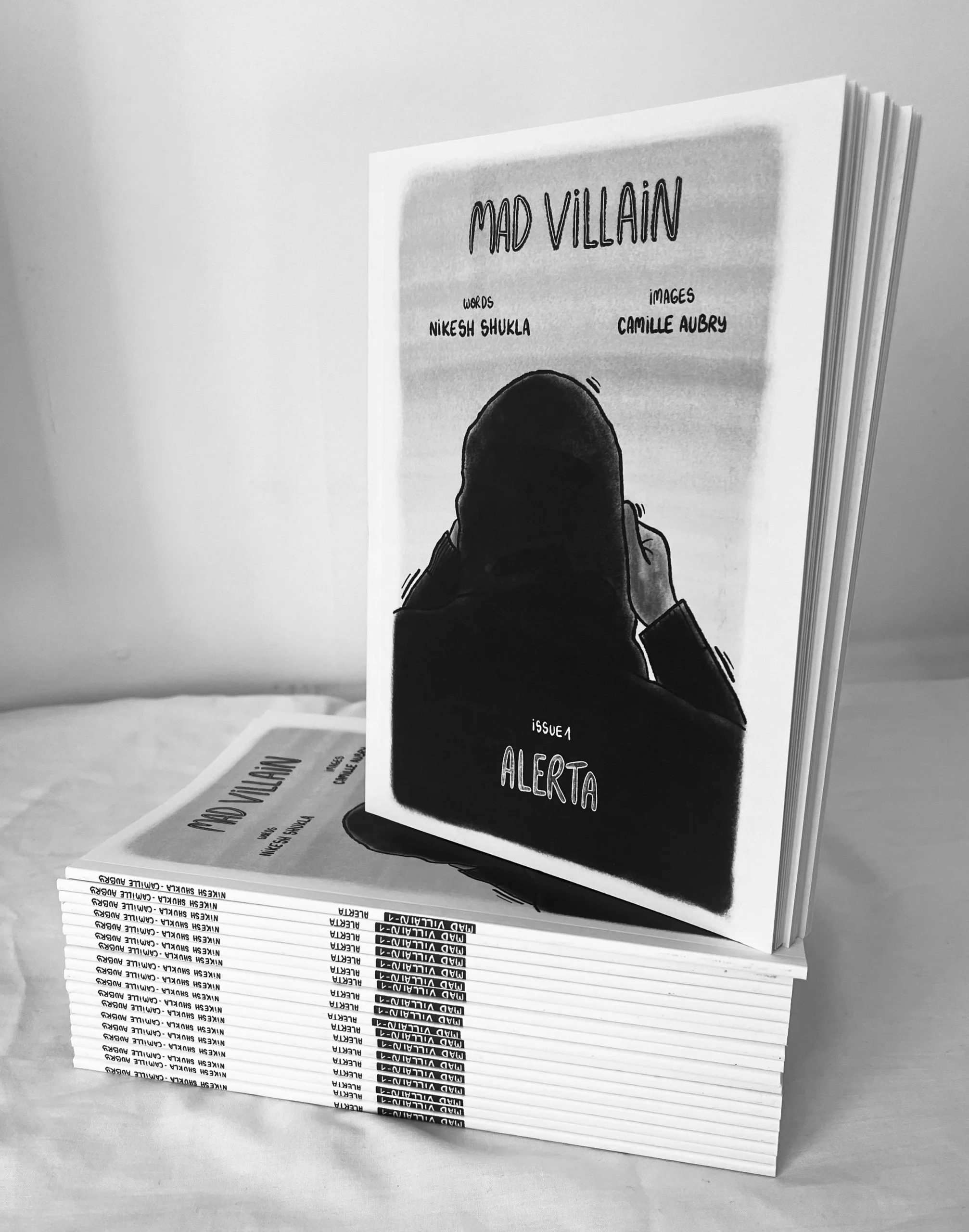
Mad Villain – Alerta Issue 1
Visit Camille’s website here.


